Campbell, CA · Garage Door Service
Why So Many Campbell Garage Doors Have No Insulation at All
Campbell homes mostly date to 1964, years before garage doors had insulation standards. Here's what that means for your door and when to call in Campbell, CA.
- Repairs & new doors
- Springs & openers
- Serving 8 nearby communities
What Changes With the Season
Campbell sits in a mild temperate band, so you don't get the freeze-thaw cycles that crack panels or seize springs the way a colder climate would. That's the good news. The bad news is that mild doesn't mean stable. Even here, daytime highs and overnight lows swing enough that a thin steel panel expands and contracts every single day, and if that panel has no foam core backing it, it does that movement on its own with nothing to buffer it. Over years, the fasteners holding hinges and rollers to an uninsulated panel work loose faster than they would on a door with a sandwiched insulated skin, because the insulated version doesn't flex as much. You won't see a dramatic seasonal failure like a frozen opener. What you'll see instead is a slow accumulation of rattle, sag at the bottom corners, and a door that gets a little harder to balance year over year. It's not dramatic, it's just steady wear with nothing softening it.
How Local Conditions Play In
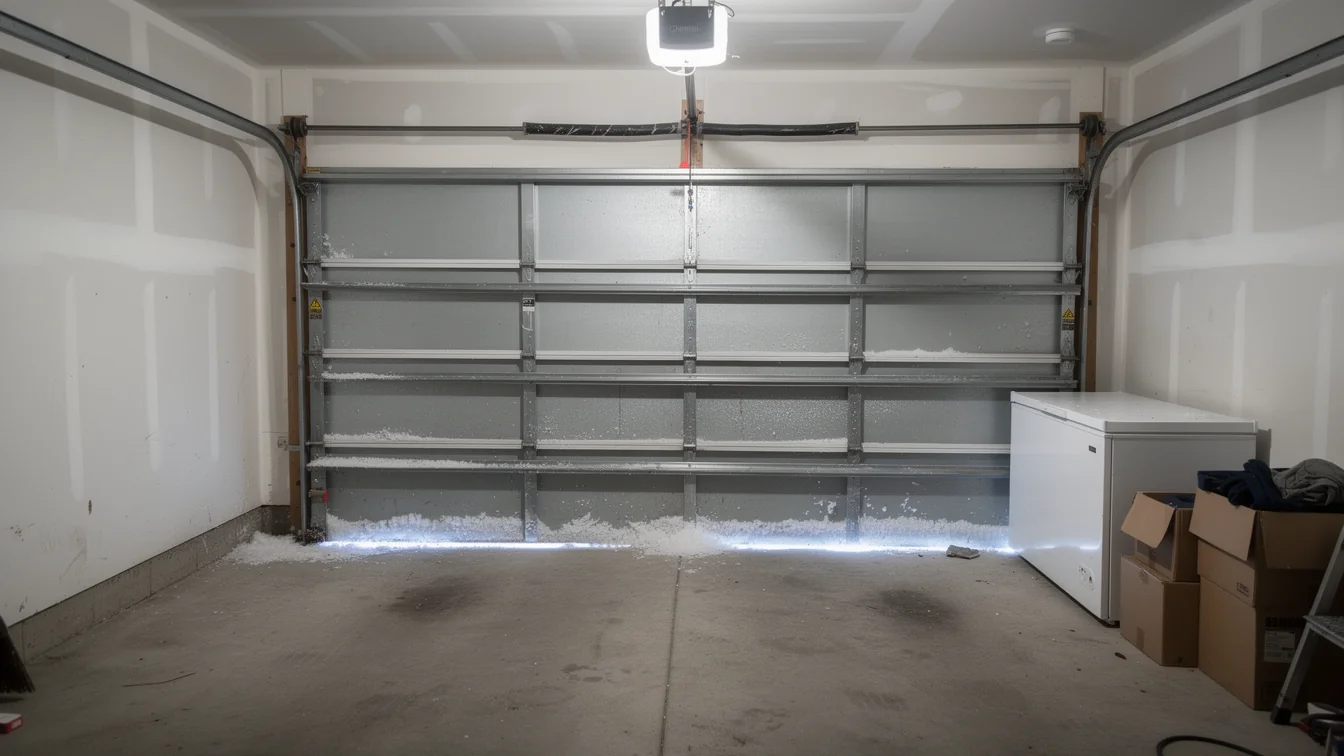
Most of the housing around here went up between 1947 and 1985, and the typical Campbell house dates to 1964 - decades before garage doors were built to any insulation standard. That matters because a door from that era, if it hasn't been replaced, is almost always a single layer of steel or a wood panel with no foam core and no thermal break at all. Nearby pockets like San Tomas, Cambrian, and Willow Glen carry the same 1960s-70s stock, so this isn't a one-street issue, it's the baseline for this part of the valley. An uninsulated door on a house like this does two things: it lets heat and noise move through the garage almost freely, and it tends to be lighter-gauge steel, which means it dents and bows more easily than anything made in the last twenty years. If your opener strains more than it used to, or the door feels like it's working harder to open, the panel itself - not just the spring - may be the actual source of the load.
When to Get Help
Call before a small problem becomes a stuck door. Warning signs on an original 1960s-era panel: visible bowing across the middle, rust starting at the bottom seam, gaps at the corners you can see daylight through, or an opener that groans and reverses on the way down. Any of those point to a panel that's lost its shape, which no amount of spring or track adjustment will fix. Here's the honest limit: if the door is original to a house built in that 1947-1985 window, we're often looking at replacement rather than repair, because matching hardware and panel profiles for doors that old simply isn't available anymore. We'll tell you straight if a repair is just delaying the inevitable. If the door is newer, or the issue is mechanical - a spring, a cable, a bent track - that's a different conversation and usually a same-visit fix.
The Problem
The real issue isn't that these doors are old. It's that they were built before anyone was required to think about insulation at all. A door hung in 1964 was built to keep rain and raccoons out, not to hold a thermal boundary between a garage and the house attached to it. No foam core, no weather seal designed for it, and often a steel gauge thin enough to dent with a bike handlebar. On a lot of Campbell houses the garage shares a wall with a bedroom or laundry room, so that uninsulated door isn't just a garage problem, it's a comfort and noise problem for whoever's on the other side of that wall. We're not going to tell you every original door needs to come out tomorrow - plenty are still structurally sound and just need adjustment. But if you're chasing drafts, noise, or an opener that's working too hard, the panel's age and lack of insulation is usually where that trail leads.
Frequently asked questions
Is my garage door original to the house if it was built in the 1960s?
It's common around Campbell, where a lot of stock dates to the 1947-1985 range with a median around 1964. If the door still has a single steel skin with no foam backing and simple hinge-and-roller hardware, it's likely original or an early replacement from before insulated doors were standard.
Does Campbell's climate make uninsulated doors a bigger problem?
Not in the dramatic way cold climates do - there's no freeze-thaw cracking here since the area sits in a mild temperate band. But daily temperature swings still flex an uninsulated panel every day, which speeds up wear at hinges and rollers over the years, even without extreme weather.
Can you add insulation to an old door instead of replacing it?
Sometimes, with a retrofit insulation kit, but it depends on the panel's condition. If the steel is bowed, rusted at the seams, or the door is original to a 1960s build, insulation won't fix the underlying structural wear, and replacement is usually the more honest recommendation.
How do I know if it's the spring or the panel causing the strain?
If the opener groans or reverses specifically while lifting, and the panel itself looks straight with no bowing or daylight gaps, it's more likely a spring or cable issue. If the panel is visibly warped or dented, the extra load is coming from the panel fighting its own shape, not just the spring.
Related garage door services in Campbell
More garage door guides
Book garage door service in Campbell
Call now or request a quote - tell us what the door is doing and where you are.